
Train Stations Spain
Train Stations Spain
Comfortable journeys offering stunning scenery along the way!
About Renfe Train Stations
Most Renfe railway stations are beneficially located in the city centre and well-connected by public transportation including trams, buses, and metro systems. Inside most station complexes you can find everything you need for a pleasant journey: a help centre, bathrooms, luggage lockers, ATMs, plenty of cafes and food shops, ticket offices, and free Wi-Fi. Major train stations in Spain feature amenities such as airport-style security checks, assistance for travelers with reduced mobility via the Atendo service, baggage storage, and extensive dining and shopping options. Travel insurance is recommended for all train journeys in Spain, particularly during busy holiday periods when delays can affect travel plans. Exploring Spain by train is one of the most rewarding ways to discover the country's diverse regions.


| High Speed Rail: AVE Network High speed trains in Spain — known as AVE (Alta Velocidad Española) — can reach speeds of up to 310 km/h, connecting Madrid and Barcelona efficiently and making Spain's high speed network one of the best in Europe. High speed rail lines in Spain require X-ray baggage screening and ticket checks prior to platform access at all major stations — allow at least 30 minutes before departure for security procedures. The ave network connects over 40 major cities across the Spanish rail network, with most high speed services radiating from Madrid and Barcelona. International train routes cross the French border at Figueres-Vilafant in north eastern Spain, connecting Barcelona with Lyon and Madrid with Marseille. Two trains sometimes operate as a single through service — a Spanish AVE and a French TGV — requiring one ticket booked online on Rail Ninja. San Sebastian and the Basque Country are also accessible via connections from France through the western French border crossing, with private companies and regional operators serving these routes alongside Renfe. |
Did you know?
Spain uses a broader rail gauge (1,668 mm) on its conventional network — wider than the standard European gauge. High-speed AVE lines, however, use the international standard gauge (1,435 mm), which is why AVE trains cannot run on the older conventional network without special variable-gauge axles.
Spain uses a broader rail gauge (1,668 mm) on its conventional network — wider than the standard European gauge. High-speed AVE lines, however, use the international standard gauge (1,435 mm), which is why AVE trains cannot run on the older conventional network without special variable-gauge axles.

| Alvia Trains and Alvia Services Alvia trains serve routes where the full AVE high speed network has not yet reached, running on both high speed lines and conventional gauge tracks. Alvia services are particularly important for connecting northern Spain, the Basque Country, Santiago de Compostela, and other destinations not yet on the pure high speed ave network. The Avant service operates short hop high speed trains between nearby cities on high speed lines, offering the fastest journey option for shorter distances. Euromed services connect Barcelona with Valencia and Alicante along the Mediterranean coast, making them a popular choice for travelers exploring eastern Spain. These trains offer the same travel classes as AVE and are fully integrated into the Renfe tickets booking system. The Avant service operates short hop high speed trains between nearby cities on high speed lines, offering the fastest journey option for shorter distances. Euromed services connect Barcelona with Valencia and Alicante along the Mediterranean coast. |

| Main Train Stations in Spain Madrid Puerta de Atocha Madrid Atocha Train Station — also known as Madrid Puerta de Atocha — is the largest train station in Spain and serves as the primary hub for the AVE high speed network, connecting Madrid and Barcelona with Seville, Malaga, Valencia, Alicante, and other major cities. The station is famous for its stunning tropical garden inside the historic 1892 trainshed — a unique attraction in its own right. Madrid Atocha serves around 88 million passengers annually and handles AVE high speed trains, long distance trains, regional trains, and Cercanías suburban services. Accessibility features including tactile paving and step-free access are fully implemented throughout the station. Madrid Chamartín Madrid Chamartín terminal handles rail traffic to northern Spain and international routes toward Portugal, as well as some AVE services to Barcelona and Zaragoza. The station serves as the second major Madrid rail hub and is connected to Madrid Atocha via the cross-Madrid underground Cercanías route. Travelers connecting between the two Madrid terminals can take the Cercanías C-3 or C-4 lines. Barcelona Sants Barcelona Sants Train Station is the main railway hub in Catalonia and one of the busiest stations in Spain, providing crucial connections for AVE trains traveling to and from Madrid and other Spanish cities. Barcelona Sants is the departure point for high speed trains to Madrid, Seville, Malaga, Valencia, and international routes to France via Girona and Figueres. The station is well integrated with Barcelona's metro systems (Lines L3 and L5) and suburban rail network. Seville Santa Justa Sevilla Santa Justa Train Station is a key stop on the AVE network and was the first station in Spain to receive high speed services from Madrid in 1992. The station links Seville to Madrid in approximately 2 hours and 30 minutes, and to Barcelona in approximately 5 hours and 30 minutes. Seville Santa Justa handles around 8 million passengers annually and serves commuter trains, regional, long distance, and high speed AVE journeys. The Sala Club lounge for Premium fare passengers is available at the station. |

| Valencia Train Station Valencia Nord Train Station is the historic main station in Valencia city centre, serving regional and long distance trains. Valencia Joaquín Sorolla station is the separate high speed rail station, facilitating quick AVE travel to and from Madrid, Barcelona, and other major cities. Both stations are connected by a free shuttle bus for passengers transferring between services. Malaga Maria Zambrano Malaga Maria Zambrano Train Station is the main railway hub in Malaga and the terminus for the Madrid–Malaga high speed AVE line. The station is located adjacent to the Malaga bus station, providing seamless connections for onward travel to the Costa del Sol and Andalusia. The Renfe Sala Club lounge and full passenger facilities are available at Malaga Maria Zambrano. Alicante Terminal Alicante Terminal Train Station is the primary railway station in Alicante, connecting the city to Madrid via the Alicante Madrid AVE line since 2013. The station is located in the heart of the city on Avenida de Salamanca and serves approximately 3 million passengers annually. Platforms 1–6 handle high speed AVE services while platforms 9–14 serve regional and suburban trains. Zaragoza Delicias Zaragoza Delicias station serves as a crucial junction on the Madrid Barcelona high speed line, making it one of the most important connecting Madrid high speed rail hubs in northern Spain. The station handles around 3 million passengers per year, mainly for high speed AVE, regional, and long distance journeys. Zaragoza is also a key stop for trains traveling to Barcelona from Madrid, with journey times of approximately 1 hour 15 minutes from Madrid and 1 hour 40 minutes from Barcelona. |
Buy Tickets: Booking Spanish Train Stations

Online Booking
Tickets can be purchased online on Rail Ninja for the best available prices across all Renfe trains, Iryo, Ouigo, and Alvia services. Reservations are generally required for long distance trains in Spain, and booking in advance can often secure better prices. Tickets can also be purchased at train stations from ticket offices or self-service machines, but it is advisable to book in advance for popular routes especially during peak travel periods. The Spain Pass offers a set number of journeys within one month.

Seat Reservation and Rail Pass
Seat reservation is mandatory on all AVE, Alvia, and long distance Renfe trains. The Eurail Pass and Spain Pass allow unlimited or multi-journey travel on Renfe services, but seat number reservations are still required for all long distance and high speed services. When booking your seat number online, you can view the train window seat options and choose your preferred position — window or aisle — for the most enjoyable ride.

Reduced Mobility and Atendo Service
All major Spanish train stations provide full accessibility with elevators, ramps, tactile paving, and adapted toilets. The Atendo service provides personalized assistance for passengers with reduced mobility at all major stations — booking 48 hours in advance is recommended. Signage at Spanish train stations is displayed in both Spanish and English, making navigation straightforward for international travelers.
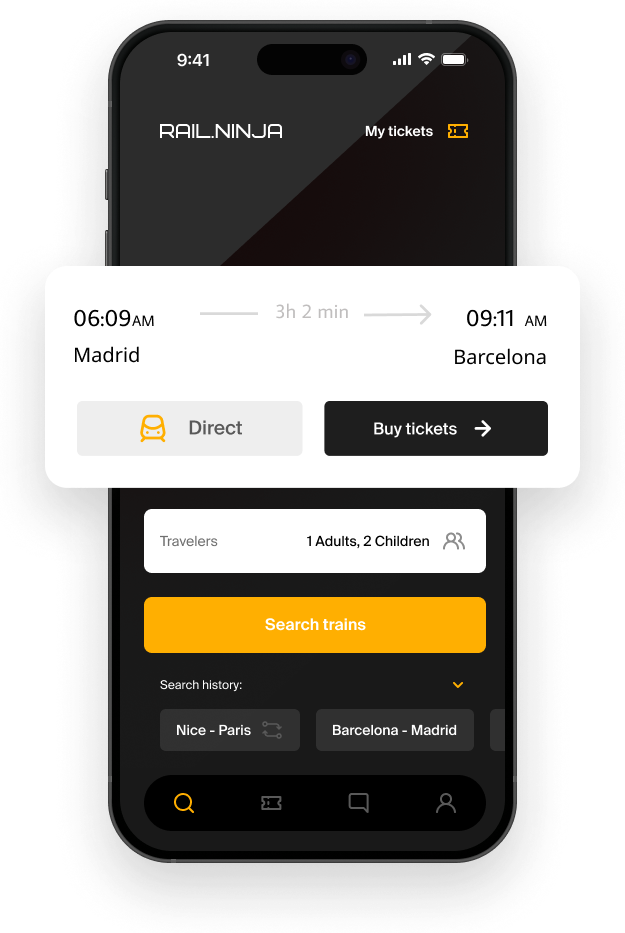
Try the new Rail Ninja application today
Get our free app to book and manage your trips on the go
Popular Renfe Railway Stations
Popular Renfe Routes